Tuesday, August 20, 2013

NOAA Says 2012 Hottest Year on Record Globally: What Are You Doing to Save the Planet?


State of the Climate in 2012 - report cover.
The 2012 State of the Climate report is available online.
(Credit: NOAA)
Worldwide, 2012 was among the 10 warmest years on record according to the 2012 State of the Climate report released online today by the American Meteorological Society (AMS). The peer-reviewed report, with scientists fromNOAA’s National Climatic Data Center in Asheville, N.C., serving as lead editors, was compiled by 384 scientists from 52 countries (highlights, full report). It provides a detailed update on global climate indicators, notable weather events, and other data collected by environmental monitoring stations and instruments on land, sea, ice, and sky. 
“Many of the events that made 2012 such an interesting year are part of the long-term trends we see in a changing and varying climate — carbon levels are climbing, sea levels are rising, Arctic sea ice is melting, and our planet as a whole is becoming a warmer place," said Acting NOAA Administrator Kathryn D. Sullivan, Ph.D. “This annual report is well-researched, well-respected, and well-used; it is a superb example of the timely, actionable climate information that people need from NOAA to help prepare for extremes in our ever-changing environment."
Conditions in the Arctic were a major story of 2012, with the region experiencing unprecedented change and breaking several records. Sea ice shrank to its smallest “summer minimum” extent since satellite records began 34 years ago. In addition, more than 97 percent of the Greenland ice sheet showed some form of melt during the summer, four times greater than the 1981–2010 average melt extent.
The report used dozens of climate indicators to track and identify changes and overall trends to the global climate system. These indicators include greenhouse gas concentrations, temperature of the lower and upper atmosphere, cloud cover, sea surface temperature, sea-level rise, ocean salinity, sea ice extent and snow cover. Each indicator includes thousands of measurements from multiple independent datasets.

Thursday, August 15, 2013

Neonode Introduces New and Inexpensive Sensors for Home Appliances

Neonode Inc., (Nasdaq:NEON), the optical touch technology company, announced today the release of its new, radically low-cost and groundbreaking Single Side Sensor (SSS), part of Neonode's Multisensing(R) family of touch and proximity solutions.


Touch Enabled Water Dispenser
Photo Credit: Neonode, Inc.
The Single Side Sensor is developed explicitly to add touch functionality to low-cost, high-volume consumer products. With an unsurpassed ultra-low BOM cost of only $1 (US) in high volumes, it is specifically designed to meet the aggressive price requirements in super cost-sensitive product segments.

This new and inexpensive sensor enables manufacturers to add touch input to a wide range of products, including wearables, low-cost printers, home appliances, toys/games, and gesture sensing mobile phone sleeves & accessories. These products are characterized by a rapid turnover and shorter life cycles.

"This is a dream come true! We can now deliver a BOM level for basic touch solutions we thought to be impossible just 12 months ago. As a technology licensing company we're clearly thrilled about the huge opportunity our innovation brings to manufacturers, who are struggling to add value, differentiate and make ends meet within the fast-growing low-end mass-markets," says Thomas Eriksson, CEO and Co-founder of Neonode.

The new Single Side Sensor integrates Neonode's NN1001 controller, optics and a small PCB, which reside on only one side of a display (or any type of surface). Consequently, this new solution requires substantially less hardware than Neonode's high-end touch solutions, which in turn lowers the Bill of Materials to an absolute minimum. In addition, this new solution can also be used in combination with Neonode's other proven and high-end technologies, for example the recently launched Circular Touch for wearables (http://bit.ly/13jDoiG).

Touch Enabled Stove
Photo Credit: Neonode, Inc.
"I am convinced that our Single Side Sensor fulfills the manufacturers needs for compact, cost-efficient and fast time to market touch solutions, and I am happy to say that we covered a milestone in leading the market trend of non-hardware, software-only touch solutions," Eriksson concludes.

Neonode's new Single Side Sensor is built on the company's latest technology and will initially support up to 7-inch displays, with a roadmap to reach larger sizes.

About Neonode
Neonode Inc. (Nasdaq:NEON) develops and licenses the next generation of Multisensing touch technologies, allowing companies to differentiate themselves by making high performing touch solutions at a competitive cost. Neonode is at the forefront of providing unparalleled user experiences that offer significant advantages for OEM's. This includes state-of-the-art touch technology features such as low latency pen or brush sensing, remarkably high speed scanning, proximity-, pressure-, and depth sensing capabilities and object-size measuring.

Neonode's patented Multisensing technology is developed for a wide range of devices such as mobile phones, tablets and e-readers, toys and gaming consoles, printers, white goods, wearable goods and advanced automotive infotainment systems. Neonode, the Neonode logo, Multisensing, and zForce are trademarks of Neonode Inc. registered in the United States and other countries. Liquid Sensing, It Makes Sense and AlwaysON are trademarks of Neonode Inc. For more information please visit www.neonode.com

Forward-Looking Statements
This press release contains forward-looking statements within the meaning of the Private Securities Litigation Reform Act of 1995. These include, but are not limited to, statements relating to expectations, future performance or future events, and product cost, performance, and functionality matters. These statements are based on current assumptions, expectations and information available to Neonode management and involve a number of known and unknown risks, uncertainties and other factors that may cause Neonode's actual results, levels of activity, performance or achievements to be materially different from any expressed or implied by these forward-looking statements.
These risks, uncertainties, and factors are discussed under "Risk Factors" and elsewhere in Neonode's public filings with the U.S. Securities and Exchange Commission from time to time, including Neonode's annual report on Form 10-K, quarterly reports on Form 10-Q, and current reports on Form 8-K. You are advised to carefully consider these various risks, uncertainties and other factors. Although Neonode management believes that the forward-looking statements contained in this press release are reasonable, it can give no assurance that its expectations will be fulfilled. Forward-looking statements are made as of today's date, and Neonode undertakes no duty to update or revise them.

Wednesday, August 7, 2013

What Homeowners Need to Know About LED Lighting

What are LEDs?

LEDs, or light–emitting diodes, are semiconductor devices that produce visible light when an electrical current is passed through them. LEDs are a type of Solid State Lighting (SSL), as are organic light–emitting diodes (OLEDs) and light–emitting polymers (LEPs).

How is LED lighting different than other light sources, such as incandescent and CFL?

LED lighting differs from incandescent and compact fluorescent lighting in several ways. When designed well, LED lighting can be more efficient, durable, versatile and longer lasting.
LED lighting products use light emitting diodes to produce light very efficiently. An electrical current passed through semiconductor material illuminates the tiny light sources we call LEDs. The heat produced is absorbed into a heat sink.
Common LED colors include amber, red, green, and blue. There is actually no such thing as a “white” LED. To get white light the kind we use for lighting our homes and offices, different color LEDs are mixed or covered with a phosphor material that converts the color of the light. The phosphor is the yellow material you can see on some LED products.  Colored LEDs are widely used as signal lights and indicator lights, like the power button on a computer.
LEDs are now being incorporated into bulbs and fixtures for general lighting applications. LEDs are small and provide unique design opportunities. Some LED bulb solutions may look like familiar light bulbs and some may not but can better match the performance of traditional light bulbs. Some LED light fixtures may have LEDs built–in as a permanent light source.
LED light fixtures
LEDs are “directional” light sources which means they emit light in a specific direction, unlike incandescent and compact fluorescent bulbs which emit light — and heat — in all directions. For this reason, LED lighting is able to use light and energy more efficiently in many applications.
Incandescent bulbs produce light using electricity to heat a metal filament until it becomes “white” hot or is said to incandesce.  As a result, incandescent bulbs release 90% of their energy as heat.
In a CFL, an electric current flows between electrodes at each end of a tube containing gases. This reaction produces ultraviolet (UV) light and heat.  The UV light is transformed into visible light when it strikes a phosphor coating on the inside of the bulb. Learn more about how CFLs work.
LED Basics
The useful life of LED lighting products is defined differently than that of other light sources, such as incandescent or CFL. This is because LEDs typically do not “burn out” or fail. Instead, they experience lumen depreciation, where the amount of light produced decreases and light color appearance can shift over time. Instead of basing the useful life of an LED product on the time it takes for 50% of a large group of lamps to burn out (as is the case with traditional sources), LED product “lifetime” is set based on a prediction of when the light output decreases 30 percent.
LEDs and Heat
Because LED lighting systems don’t radiate heat the way an incandescent or halogen light bulb does, the heat produced from the power going into the product must be drawn away from the LEDs. This is usually done with a heat sink, which is a passive device that absorbs the heat produced and dissipates it into the surrounding environment. This keeps LEDs from overheating and burning out. Thermal management is probably the single most important factor in the successful performance of an LED product over its lifetime because the higher the temperature at which the LEDs are operated, the more quickly the light will degrade, and the shorter the useful life will be.
LED products use a variety of unique heat sink designs and configurations to manage heat, so they may look very different from each other. Regardless of the heat sink design, all LED products that have earned the ENERGY STAR have been tested to ensure that they properly manage the heat so that the light output is properly maintained through the end of its rated life.
By Energy Star

Saturday, August 3, 2013

ENERGY STAR Teaches Homeowners How to Air Seal and Insulate Their Homes

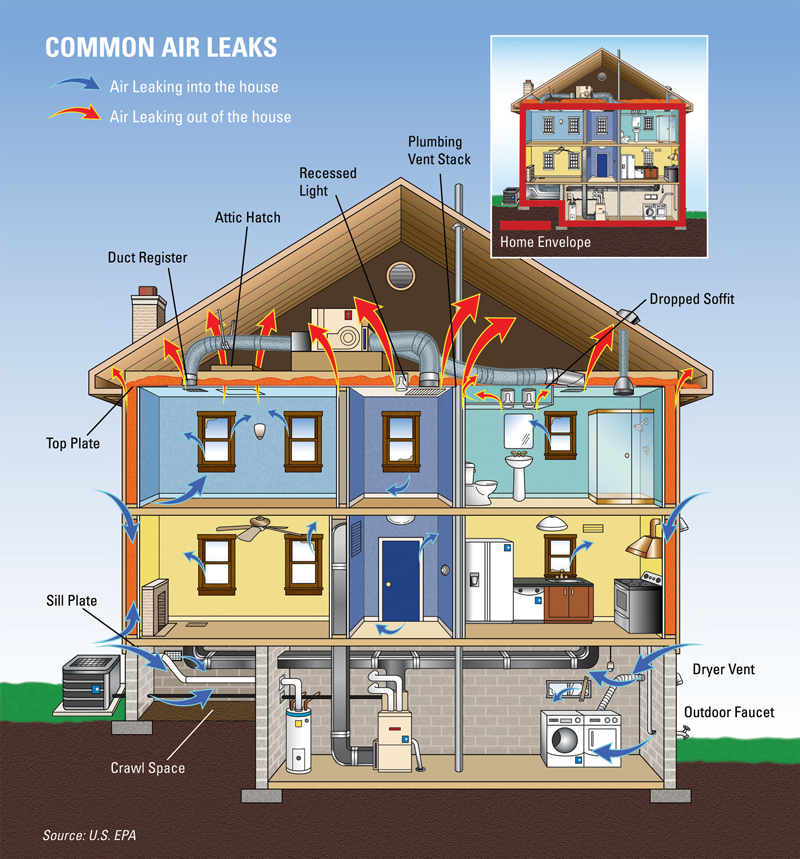
Sealing and insulating the "envelope" or "shell" of your home — its outer walls, ceiling, windows, doors, and floors — is often the most cost effective way to improve energy efficiency and comfort. ENERGY STAR estimates that a knowledgeable homeowner or skilled contractor can save up to 20% on heating and cooling costs (or up to 10% on their total annual energy bill) by sealing and insulating.
To Seal and Insulate with ENERGY STAR:
  • Seal air leaks throughout the home to stop drafts,
  • Add insulation to block heat loss in winter and heat gain in summer,
  • Choose ENERGY STAR qualified windows when replacing windows.
If your attic is accessible and you like home improvement projects, you can Do-It-Yourself with help from our DIY Guide to Sealing and Insulating with ENERGY STAR. The Guide offers step-by-step instructions for sealing common air leaks and adding insulation to the attic.
You can also hire a contractor who will use special diagnostic tools to pinpoint and seal the hidden air leaks in your home. AHome Energy Rater can help you find contractors that offer air sealing services in your area.
In addition, there are qualified contractors that participate in local Home Performance with ENERGY STAR programs across the country.

Sealing Leaks

Many air leaks and drafts are easy to find because they are easy to feel — like those around windows and doors. But holes hidden in attics, basements, and crawlspaces are usually bigger problems. Sealing these leaks with caulk, spray foam, or weather stripping will have a great impact on improving your comfort and reducing utility bills. Click on the house diagram to see common air leak locations that you should aim to seal.
Homeowners are often concerned about sealing their house too tightly; however, this is very unlikely in most older homes. A certain amount of fresh air is needed for good indoor air quality and there are specifications that set the minimum amount of fresh air needed for a house. If you are concerned about how tight your home is, hire a contractor, such as a Home Energy Rater, who can use diagnostic tools to measure your home's actual leakage. If your home is too tight, a fresh air ventilation system may be recommended.
After any home sealing project, have a heating and cooling technician check to make sure that your combustion appliances (gas- or oil-fired furnace, water heater, and dryer) are venting properly. For additional information on Indoor Air Quality (IAQ) issues related to homes, such as combustion safety, visit EPA’s Indoor Air Quality Web site.

Adding Insulation

Insulation keeps your home warm in the winter and cool in the summer. There are several common types of insulation — fiberglass (in both batt and blown forms), cellulose, rigid foam board, and spray foam. Reflective insulation (or radiant barrier) is another insulating product which can help save energy in hot, sunny climates.
When correctly installed with air sealing, each type of insulation can deliver comfort and lower energy bills during the hottest and coldest times of the year.
Insulation performance is measured by R-value — its ability to resist heat flow. Higher R-values mean more insulating power. Different R-values are recommended for walls, attics, basements and crawlspaces, depending on your area of the country. Insulation works best when air is not moving through or around it. So it is very important to seal air leaks before installing insulation to ensure that you get the best performance from the insulation.
To get the biggest savings, the easiest place to add insulation is usually in the attic. A quick way to see if you need more insulation is to look across your uncovered attic floor. If your insulation is level with or below the attic floor joists, you probably need to add more insulation. The recommended insulation level for most attics is R-38 (or about 12–15 inches, depending on the insulation type). In the coldest climates, insulating up to R-49 is recommended.

Sealing Ducts

Duct Sealing GuideIn houses with forced-air heating and cooling systems, ducts are used to distribute conditioned air throughout the house. In a typical house, however, about 20 percent of the air that moves through the duct system is lost due to leaks and poorly sealed connections. The result is higher utility bills and difficulty keeping the house comfortable, no matter how the thermostat is set.
Because some ducts are concealed in walls and between floors, repairing them can be difficult. However, exposed ducts in attics, basements, crawlspaces, and garages can be repaired by sealing the leaks with duct sealant (also called duct mastic). In addition, insulating ducts that run through spaces that get hot in summer or cold in winter (like attics, garages, or crawlspaces) can save significant energy.
Additionally, if you are replacing your forced-air heating and cooling equipment, make sure your contractor installs the new system according to ENERGY STAR quality installation guidelines. A quality installation will include a thorough inspection of your duct system, including proper sealing and balancing of ductwork, to help ensure that your new system delivers the most comfort and efficiency.

Friday, July 19, 2013

Study by Rice University Says Houston Neighborhoods at Higher Risk for Cardiac Arrests

A Rice University/City of Houston study being published in the August edition of the American Journal of Preventive Medicine finds greater risk of cardiac arrest and lower cardiopulmonary resuscitation (CPR) in a corridor of Houston that runs right down the middle of the city. 

A new collaboration between the Houston Department of Health and Human Services and the local chapter of the American Heart Association is aimed at addressing the problem through increased availability of CPR training.  So far, more than 4,200 people in the targeted neighborhoods have been trained in hands-only CPR.


“Due to the work of our emergency responders, the local cardiac arrest survival rates are among the best in the nation,” said Mayor Annise Parker.  “However, your chances of survival are even better when a bystander steps in to help with CPR in the minutes before emergency help arrives.  In the longer term, the overall goal must be reduction in the incidence of cardiac arrest.  We have to continue work to improve area air quality and achieve healthier lifestyles.”

The at-risk neighborhoods generally follow a corridor along Highway 288 and Highway 59 North and include Sunnyside, South Park, Riverside, Magnolia, Denver Harbor and 5th Ward.  Acres Homes is a separate area also identified by the study as heavily affected.

“The opportunity to bring quality science expeditiously to the benefit of the community is a noted outcome of this work as well as our on-going collaboration,” said David Persse, EMS director and health authority for the Houston Department of Health and Human Services.

The city and the American Heart Association earlier this year launched the neighborhood outreach program that educates residents of the affected communities on the importance of bystander CPR and how to conduct CPR. The city coordinates and pays for the training. The association trains the residents to perform CPR.

Monday, July 15, 2013

NAHB Shares Complete List of all 255 Metros Currently on Improving Markets Index

A total of 255 metropolitan areas across 49 states and the District of Columbia qualified to be listed on the National Association of Home Builders/First American Improving Markets Index (IMI) for July, released today. This is down slightly from the 263 metros that made the list in June, but is more than triple the number of metros that were on it in July of 2012.

The IMI identifies metropolitan areas that have shown improvement from their respective troughs in housing permits, employment and house prices for at least six consecutive months. Six new markets were added to the list and 14 were dropped from it in July. Newcomers include the geographically diverse metros of Cumberland, Md.; Saginaw, Mich.; Farmington and Las Cruces, N.M.; Kingston, N.Y.; and Olympia, Wash.

“This is the sixth straight month in which at least 70 percent of all U.S. metros have qualified for the Improving Markets Index,” observed NAHB Chairman Rick Judson. “The relative stability of the IMI is representative of the broad recovery underway, which is much more extensive than what we were looking at one year ago.”

“Despite slight ups and downs in recent IMI levels, an overwhelming majority of U.S. metros -- including those located in almost every state -- remain solidly on the path to recovery even as the pace of their improvement is slowed by ongoing challenges related to the availability of credit, labor, lots and certain building materials,” added NAHB Chief Economist David Crowe. “Based on recent trends in home prices, housing permits and employment, the outlook for a continued housing expansion remains very positive for the remainder of 2013.”

“The fact that more than two-thirds of all U.S. housing markets continue to be represented on the improving list should be a boon to consumer confidence at a time when many are looking to take advantage of today’s very favorable mortgage rates,” observed Kurt Pfotenhauer, vice chairman of First American Title Insurance Company.

The IMI is designed to track housing markets throughout the country that are showing signs of improving economic health. The index measures three sets of independent monthly data to get a mark on the top Metropolitan Statistical Areas. The three indicators that are analyzed are employment growth from the Bureau of Labor Statistics, house price appreciation from Freddie Mac and single-family housing permit growth from the U.S. Census Bureau. NAHB uses the latest available data from these sources to generate a list of improving markets. A metro area must see improvement in all three measures for at least six consecutive months following those measures’ respective troughs before being included on the improving markets list.

A complete list of all 255 metros currently on the IMI, and separate breakouts of metros newly added to or dropped from the list in July, is available at www.nahb.org/imi.

Friday, July 12, 2013

Energy Saving Tips for Your Attic

Energy Saving Tips for Your Attic

The attic is one of the places where you often find the biggest air leaks, which can increase your energy bills and make you uncomfortably hot in summer and cold in winter. It is also a place that is generally accessible, making it easier to air seal and insulate to improve your home's comfort and overall energy performance.

Attic Ventilation


Attic Before Renovation
Proper ventilation of the attic with natural air flow keeps the roof deck cool and dry, extending the life of roof shingles and preventing ice dams without using the energy needed to run an attic vent fan. Be sure attic soffit vents and gable vents are not blocked so air flows freely through them. Some homes have ridge vents or vents through the roof deck instead of gable vents. Learn more in the DIY Guide to Sealing and Insulating with ENERGY STAR.

Ducts


Look for holes, tears, and other signs of leaking ducts and seal them using mastic or metal (foil) tape (never use 'duct tape,' as it is not long-lasting). Insulate all the ducts you can access (such as those in the attic, crawlspace, unfinished basement, or garage).

Ducts are used to distribute conditioned air throughout houses with forced-air heating and cooling systems. In typical houses, about 20% of the air that moves through the duct system is lost due to leaks, holes and poorly connected ducts. The result is an inefficient HVAC system, high utility bills, and difficulty keeping the house comfortable, no matter how the thermostat is set. See our Duct Sealing brochure PDF (1.3MB) for more information on steps you can take to improve your home's duct system.

Attic Hatch or Door


Attic After Renovation by Incredible Renovations, Houston, TX
Weather strip and insulate your home's attic hatch or door to help keep your home more comfortable and save energy. You can do this with weatherizing materials and insulation or with a pre-made attic cover available from local home improvement centers and on the web.

The exterior of your home — the outer walls, ceiling, windows, and floor — is called the "envelope" or "shell." Sealing and insulating — done by a knowledgeable homeowner or skilled contractor — can save more than $200 a year in heating and cooling costs (or up to 10% on total annual energy bills). It will also make your home more comfortable and help your heating and cooling system run more efficiently. If your attic is accessible and you like home improvement projects, you can Do-It-Yourself with help from our DIY Guide to Sealing and Insulating with ENERGY STAR, which offers step-by-step instructions for sealing common air leaks and adding insulation to the attic.

 You can also hire a contractor who can use special diagnostic tools to pinpoint and seal the hidden air leaks in your home before adding insulation. To get the biggest savings, the easiest place to add insulation is usually in the attic. A quick way to see if you need more insulation is to look across your uncovered attic floor. If your insulation is level with or below the attic floor joists, you probably need to add more. The recommended insulation level for most attics is R-38 (or about 12–15 inches, depending on the insulation type). In the coldest climates, insulating up to R-49 is recommended.

More Information: www.energystar.gov

Information regarding Attic Conversions: http://www.incrediblerenovations.com/attic-conversions.html